Most deaths in CS2 don’t happen because someone had better aim. They happen because someone peeked badly like wrong timing, wrong angle, wrong technique. Peeking is one of the most fundamental skills in the game and one of the least understood at most ranks.
This guide covers everything: what peeking actually is, every technique you need to know, the mechanics behind why it works, common mistakes, and how to practice it properly.
What Is Peeking in CS2?
Peeking is the act of moving out from behind cover to gather information, bait a shot, or engage in a duel. The goal of any peek is simple: get as much advantage as possible with as little risk as possible. That means being fast, surprising, and in control of what angles you’re exposing yourself to at any given moment.
The player who peeks poorly dies. The player who peeks well dictates the pace of the round.
Peeker’s Advantage — Understanding the Mechanic
Before getting into technique, you need to understand why peeking works at a mechanical level.
What Is Peeker’s Advantage?
Peeker’s advantage is the brief timing edge the peeking player has over the player holding an angle. Because of network latency, the player moving out from cover sees the stationary opponent slightly before the stationary opponent sees them. The peeker’s action reaches the server before the defender’s reaction is processed.
How CS2’s Sub-Tick System Changed Things
CS2 moved to a sub-tick architecture, which registers actions between server ticks rather than at fixed intervals. This made shot registration more consistent and reduced some of the randomness that existed in CS:GO. However, sub-tick did not eliminate peeker’s advantage, it’s fundamentally a ping and latency issue, not a tick rate issue. Your success in peeking duels now comes down to movement, ping, and strategy rather than whether your action landed on the right tick.
How to Use It
On T-side, exploit peeker’s advantage by swinging aggressively when you have information. On CT-side, counter it with off-angles, utility, and repositioning rather than sitting static on a pre-aimed angle and hoping your reaction time is faster.
The Fundamentals Before You Peek
Counter-Strafing
Counter-strafing is the most important mechanical skill attached to peeking. When you’re moving, your shots are inaccurate. To stop instantly and shoot accurately, you press the opposite movement key. If you’re strafing right (D), you tap left (A) to kill your momentum. This brings your character to a full stop immediately instead of sliding to a halt, which gives you accurate shots while the enemy is still tracking your movement.
Every good peek in CS2 starts and ends with counter-strafing. If you can’t counter-strafe cleanly, your peeking will never be consistent.
Crosshair Placement
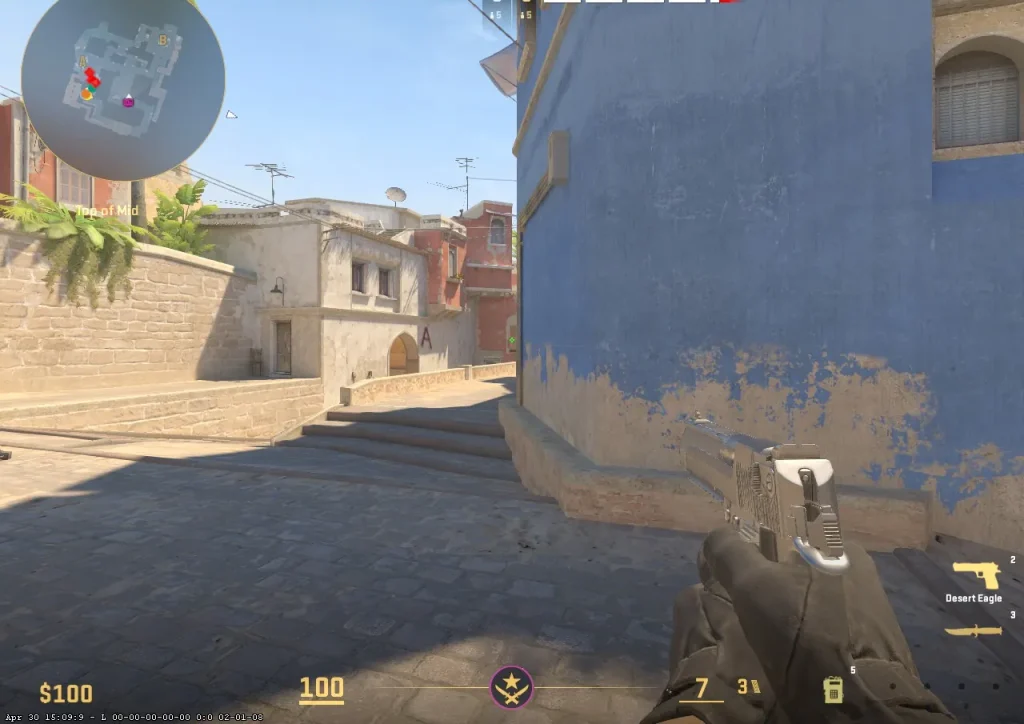
Before you even think about peeking, your crosshair needs to be pre-aimed at the angle you’re about to clear. If your crosshair is at the floor when you swing out, you’re already dead. Keep it at head height, positioned at the edge of wherever the enemy is likely to be standing. The less you have to move your crosshair when an enemy appears, the better your chance of winning the duel.
Distance From the Corner
The closer you are to a corner, the more your field of view narrows. Hugging a wall and peeking from right next to it gives the enemy a wider view of you before you can see them. Standing further back from the corner before you peek opens up your sightlines faster and gives you the geometry advantage. The general rule: don’t press yourself against cover before you peek.
Every Type of Peek in CS2
Jiggle Peek
The jiggle peek is a quick side-to-side strafe from behind cover. You expose yourself for a fraction of a second, then immediately return to cover. The purpose is information gathering. You’re trying to spot where an enemy is without fully committing to a fight.
How to do it
Move to the edge of cover. Strafe out briefly, no longer than half a second, and immediately strafe back. Counter-strafe on the way out and on the way back. Repeat until you have the information you need or you’ve baited out a shot.
When to use it
When you don’t know if an angle is held. When you need to call out a position for your team. When you want to bait an AWP shot before committing to the fight.
Shoulder Peek
The shoulder peek is similar to a jiggle peek but even more minimal. The goal is to show only your shoulder, not your head. You’re not trying to gather visual information for yourself; you’re trying to get the opponent to shoot at nothing so you can peek them for free immediately after.
How to do it
Stand close to the corner. Quickly pop out and back in, barely enough to flash your shoulder model. The enemy fires at where your head was going to be. You immediately swing back out and take the free shot while they’re mid-reload or mid-recover.
When to use it
Almost exclusively against AWPers. If you can bait the shot, the AWP is on a reload and you have a window to push or reposition safely.
Wide Peek
A wide peek is a fast, committed swing out from cover that takes you well past the corner rather than hugging it. The idea is to move further than the angle the enemy is pre-aiming. Because they’re holding a tight angle close to the corner, your wide swing forces them to flick their crosshair, which increases the chance they miss or react too slowly.
How to do it
Run at speed. Don’t slow down and hug the corner, commit to the swing and take yourself a step or two past the edge. Counter-strafe to stop at your chosen position and fire.
When to use it
When you have information on exactly where an enemy is holding. Wide peeking without information is gambling. Wide peeking when you know the angle and can pre-fire is a calculated, high-percentage play.
The crossfire risk
Wide peeking into multiple enemies is how you die fast. Before committing to a wide swing, make sure you’ve accounted for every angle you’ll be exposed to. Swinging into one enemy while another is watching from a second angle is a two-for-one in the enemy’s favour.
Regular Peek (Entry Peek)
A standard committed peek. You move out from cover, stop, and engage. The difference between this and a wide peek is mostly intent and distance. An entry peek is used when you’re taking a position, clearing a corner, or playing an aggressive T-side angle. You’re going in with the aim of either killing the opponent or forcing a trade.
How to do it
Pre-aim the angle before you move. Peek at pace, counter-strafe to stop, fire.
When to use it
Site takes. Aggressive CT plays. Any situation where you have a read on a position and you’re committing to the fight rather than just gathering info.
Combo Peek / Crouch Peek
A crouch peek introduces a vertical component. You swing out and immediately crouch, changing your hitbox positioning and dropping below where the enemy expects your head to be. It’s about being harder to headshot in the moment of exposure.
When to use it
Close-range duels where headshots are the primary threat. Combined with movement, crouching mid-peek changes your profile enough to win duels you’d otherwise lose. Don’t crouch and stay crouched. Crouch, fire, and recover your positioning quickly.
Flash Peek
Any of the above peeks can be combined with utility. A flash peek means using a flashbang to blind the enemy before you swing out. If the enemy is blinded, peeker’s advantage becomes a free kill.
Two ways to flash peek
The first is a full blind flash. You throw a flash that actually blinds the opponent, then immediately swing out into them while they can’t see. Timing is critical; the flash needs to pop just before you peek, not after.
The second is a bait flash. You throw an obvious flash to make the enemy look away or reposition, then use that distraction to peek from a different angle or a different timing entirely.
Be careful throwing flash peeks: the sound of pulling out a grenade is audible to nearby enemies. Pre-right-clicking to prepare the throw makes a sound that can telegraph your play.
Right Side vs Left Side Peeking
Your weapon is in your right hand by default, and your camera is shifted slightly to the right of your character model. This means when you peek from the right side of a corner, you see the enemy earlier relative to how much of your body is exposed. Peeking from the right side is mechanically more efficient. You need to expose less of your model to see the same amount.
This doesn’t mean you should only ever peek right, but it’s worth knowing when you have the choice.
Common Peeking Mistakes
Peeking the same angle twice in a row
If you peek, miss or get traded, and immediately re-peek the exact same way, the opponent is pre-aimed and waiting for you. Change the angle, use a shoulder peek to bait first, or use utility before re-engaging.
Hugging the wall before peeking
Standing right against cover before you move cuts off your sightlines. Back up, then swing.
Peeking multiple angles at once
The most common way to die in CS2 is exposing yourself to two enemies simultaneously. Clear one angle at a time.
Slow peeks
A slow peek combines the worst of both worlds. You’re exposed for longer, giving the enemy time to react, but you’re not far enough out to create the geometry advantage of a wide peek. Either commit fast or use a jiggle to gather info first.
Peeking without information
Swinging wide into an unknown angle with no context on where the enemy is is a coin flip. Use jiggle peeks, listen to footsteps, use your team’s calls, and check the radar before you commit.
Peeking as CT vs T
CT Side
On CT side, your job is mostly to hold angles and make the T-side attack difficult. That said, passive holding is not always the right call. Holding the same angle in the same spot every round makes you predictable and easy to flash or utility off an angle. Mix up your positions, hold off-angles, and don’t be afraid to re-peek aggressively if you trade a shot and need to finish the enemy.
T Side
Peeker’s advantage works in your favour on T-side. Use it. Entry players should swing aggressively with information from their team. Communicate what you see, call out positions immediately after a peek, and use utility to isolate the duels you’re taking. One enemy at a time wherever possible.
How to Practice Peeking
Workshop Maps
The 5E_Prac series on the Steam Workshop is one of the best tools for practicing peeks on actual matchmaking maps. It lets you train specific corners and angles from the maps you’ll actually play in competitive.
Yprac prefire maps are also excellent for crosshair placement and pre-aiming habits, which feed directly into better peeking.
What to Focus On in Practice
Counter-strafe first. If your movement isn’t clean, nothing else matters. Practice stopping cleanly before you work on the peek itself.
Then work on crosshair placement, where your crosshair is when you arrive at the corner. Then practice the peek at pace. Don’t grind bots mindlessly. Visualise where the enemy will be before you move, then execute.
Watch Pro Demos
Watch demos from pro players from their own perspective. Study where their crosshair is before they peek, how far from the corner they stand, and the pace at which they swing. The fundamentals are the same at any rank, the pros just do them faster and with better information.
Key Takeaways
Peeking is not just sticking your head out. Every peek should have a purpose. Information, a baited shot, or a committed entry. The technique you use depends on what you know and what you’re trying to achieve.
Master counter-strafing first. Keep your crosshair pre-aimed. Stand back from the corner. Use utility when you can. And never peek the same angle the same way twice in a row.
Everything on this page is a mechanical skill. It improves with deliberate practice, not just game volume.