Two players peek the same corner. One lands the kill instantly. The other dies before their crosshair even reaches head level. The difference almost always comes down to one of two fundamental techniques: pre-aiming and tracking corners in CS2. Understanding when to use each, and why, separates players who win duels consistently from those who rely on reaction time alone.
Both techniques are rooted in the same principle: your crosshair should never be in the wrong place when an enemy appears. But how you get it to the right place depends entirely on the situation. This guide breaks down the mechanics behind pre-aiming and corner tracking, and gives you a clear framework for choosing between them.
The difference between tracking and pre-aiming
Pre-aiming and corner tracking are not interchangeable. They solve different problems, and confusing them is one of the most common reasons players lose angles they should win.
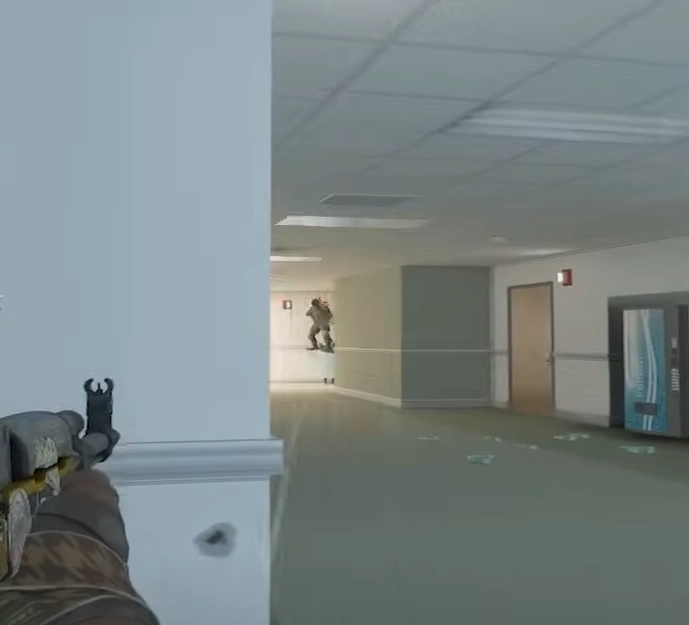
Pre-aiming means placing your crosshair at an anticipated enemy position before you expose yourself. The idea is to estimate exactly where the enemy’s head will be, lock your crosshair on that spot, and then use movement keys alone to swing out. Your mouse barely moves. The enemy appears, and the shot is already lined up. It turns a reactive flick into a simple click.
Corner tracking, sometimes called corner smoothing, works differently. Instead of committing to a fixed point, you coordinate your mouse movement with your lateral movement so your crosshair stays glued to the wall edge as you clear the angle. You are essentially tracing the corner, ready to shoot wherever the enemy happens to be standing. It is a more adaptive technique, built for uncertainty rather than prediction.
The key distinction is information. Pre-aiming is a precision tool that requires confidence in where the enemy is. Tracking is an adaptability tool for when that confidence is not there.
When to pre-aim and when to track
Choosing between these two techniques comes down to how much you know about the enemy’s position and how much angle advantage you hold.
Use pre-aiming when you have solid intel, whether from a teammate’s callout, a previous round’s pattern, or the simple fact that the angle is a well-known default. Common head-glitch positions, tight entry corners, and spots where players almost always hold the same way are all strong candidates. Because you are committing your crosshair to a specific point, the payoff is maximum first-shot accuracy with minimal mouse movement.
Use corner tracking when you are clearing unknown territory, sweeping off-angles, or taking site control without any prior information. If there is a realistic chance the enemy is standing somewhere unexpected, tracking ensures your crosshair is already at head level and only needs a small adjustment to connect. It is the safer default when uncertainty is high.
There is also a positional factor that many players overlook: the angle advantage rule. The further back you are from the corner you are clearing, the more of the enemy you will see before they see you. At a distance, pre-aiming further out from the wall makes sense because you have time to react. When you are pressed close to a corner yourself, tracking is the safer approach. It lets you clear the immediate threat without over-flicking past a close-range enemy or getting caught mid-swing.
How movement and crosshair placement interact
Both techniques depend on the relationship between your movement and your mouse, and getting that relationship wrong undermines whichever technique you are using.
For pre-aiming, movement does most of the work. You set your crosshair, then strafe out using only your keyboard. The goal is to eliminate horizontal mouse movement entirely during the peek. Any unnecessary mouse input introduces error and slows down your effective reaction time. The cleaner the pre-aim, the less you have to do when the enemy appears.
For corner tracking, the coordination between mouse and keyboard is more active. As you move laterally, your mouse needs to mirror that movement at a matching pace so your crosshair stays on the wall edge rather than drifting behind it or snapping ahead. Think of it as keeping your crosshair magnetically attached to the corner as you slice the pie. This takes deliberate practice because the natural tendency is to either stare statically at the crosshair center or let the crosshair lag behind your movement.
One principle applies to both techniques without exception: crosshair height. Your crosshair should always sit at head level, never scanning the ground or the sky. This is the single most consistent habit that separates players who win first duels from those who do not. Combine that with a mindset shift, actively expecting the enemy to be there rather than hoping they are not, and your reaction time drops noticeably because your brain is already primed to pull the trigger.
Common mistakes that cost duels
Even players who understand the theory behind CS2 pre-aim technique and corner tracking often fall into patterns that undermine both. Recognising these habits is the first step to eliminating them.
Staring at the wall instead of the edge. A common error during corner tracking is fixating on the center of your crosshair rather than the edge of the wall or object you are clearing. Your eyes should be on the corner itself so you can react to any micro-movement the moment the enemy becomes visible. Crosshair-focused players are always a fraction of a second behind.
Pre-aiming without intel. Committing your crosshair to a specific spot when you have no reliable information is a gamble, not a technique. If the enemy is standing slightly off-angle, your crosshair is in the wrong place and you are already losing the duel. Pre-aiming works because of the information behind it, not despite the lack of it.
Peeking too close to the corner. Getting right up against a wall before peeking removes your angle advantage and forces you to clear the corner at close range with limited time to react. Holding distance before you peek gives you more visual information sooner and makes both pre-aiming and tracking more effective.
Inconsistent crosshair height. Dropping your crosshair to chest or stomach level, even briefly, means that a kill which should have been a headshot becomes a body shot or a miss. Building the habit of maintaining head-level crosshair placement at all times, not just during active duels, is one of the highest-return mechanical improvements available in CS2.
Mastering these two techniques will not make every duel feel easy, but it will make far fewer of them feel unfair. The players who consistently win first contact do so because their crosshair is already in the right place before the enemy appears. That is not luck. That is deliberate, repeatable mechanics built through understanding and practice.