Aim speed separates players who win duels from players. The frustrating part is that most players try to fix the wrong thing. They chase faster mouse movement when the real bottleneck is earlier in the chain. Understanding how aim speed actually works in CS2 changes how you train and where you focus.
What actually affects your aim speed in CS2?
Aim speed in CS2 is not just how fast you move your mouse. It is the total chain from seeing an enemy to landing the shot: see, decide, move, shoot. Most players lose duels at the decide step, not the move step. Cutting decision time is where the biggest gains are.
Human reaction time sits between 150 and 250 milliseconds under normal conditions. Competitive players push below 200ms. Most CS2 duels resolve within 300ms, which means the entire chain has to run efficiently. Not just the physical mouse movement at the end of it.
Several factors directly affect how fast that chain runs:
- Sleep quality: Fatigue slows cognitive processing, especially the decide step
- Hydration: Even mild dehydration measurably slows reaction and processing speed
- Alcohol: Increases reaction latency, avoid it before any serious session
- Distraction: Background noise, phone notifications, and split attention all increase the time between seeing and deciding
- Physical fitness: Cardiovascular health correlates with cognitive processing speed over the long term
There is also a mechanical dimension. Large flick movements use the full arm, shoulder, and elbow working together. Micro-corrections at head level use the wrist and fingers. Pro consensus leans toward arm-based aiming as more consistent and repeatable. A large mousepad, elbow resting at the desk edge, and a relaxed shoulder support that approach. The goal through training is muscle memory reliable enough that none of this requires conscious thought during a duel.
What CS2 sensitivity settings help you aim faster?
Most competitive CS2 players use 400 to 800 DPI combined with 1.5 to 2.5 in-game sensitivity, producing an eDPI of roughly 600 to 2000. Too low and you cannot reach distant targets quickly in close-range duels. Too high and you overshoot micro-corrections at head level, where most kills actually happen.
Finding your personal range matters more than matching any specific pro. Use Aim Botz in the workshop and test different values in headshot-only mode. Once you find a setting that lets you both flick to targets and hold still on a head, stop changing it. Sensitivity consistency builds muscle memory, and muscle memory is what makes aim feel automatic under pressure.
Remember to turn mouse acceleration off: Disable it in both Windows mouse settings and CS2. Acceleration makes movement unpredictable at speed
Display setup also feeds into this. 144Hz is the minimum for competitive play; 240Hz is the practical recommendation. Keeping in-game FPS above 300 reduces input lag measurably. Set fps_max 0 or fps_max 400 in your autoexec.cfg and run fullscreen rather than borderless window for the lowest-latency output.
How does crosshair placement improve your aim in CS2?
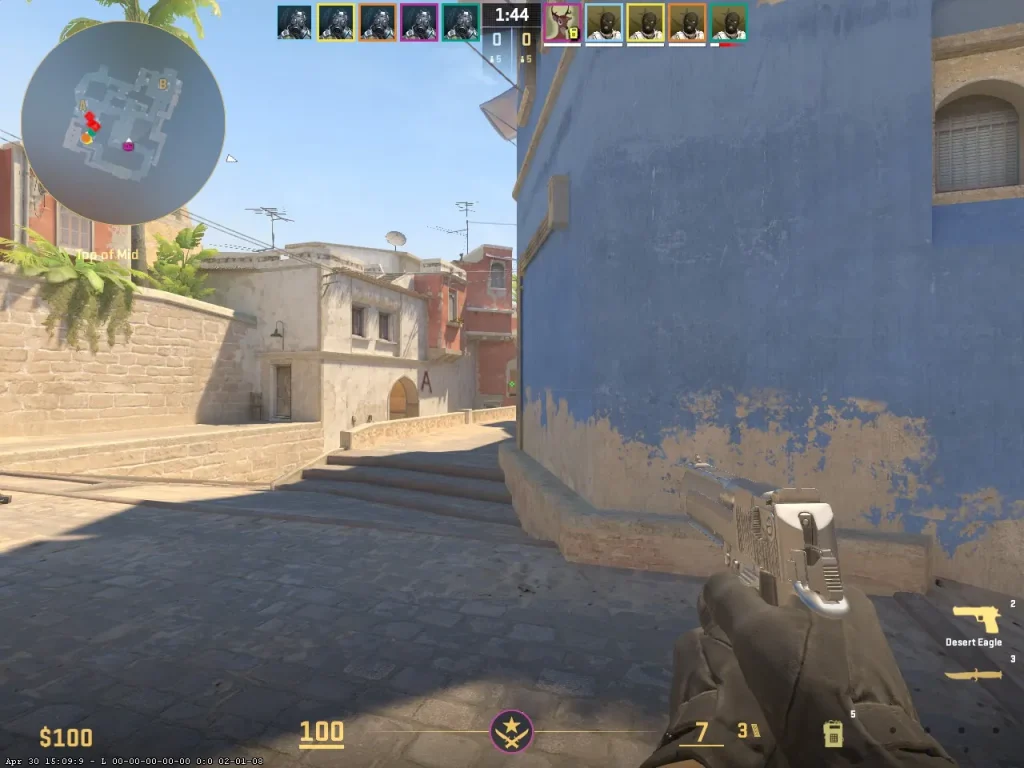
Crosshair placement reduces how far your mouse needs to travel to reach the target. When your crosshair is already at head height at the corner an enemy will appear from, the movement required is near zero. This is how players appear to aim faster than their reaction time should allow, they positioned the crosshair before the enemy was visible.The apparent speed is not mechanical reaction, it is anticipation. The see step is compressed almost entirely by pre-aim, and the result looks faster than it physically is.
Practical crosshair placement habits to build:
- Hold your crosshair at head height between duels, never at chest or floor level
- Pre-aim the exact position where an enemy head will appear when they step out from cover
- Know where enemies will be before opening an angle, not after
- Train peripheral awareness so you register movement at the screen edges, not just the center
Yprac maps in the workshop are built specifically for this. They drill map-specific pre-aim positions on Mirage, Inferno, and other competitive maps so the right crosshair position becomes automatic rather than something you calculate mid-round.
What are the best aim training methods for CS2?
The most effective approach is a structured 20 to 30 minute warm-up done before competitive or FACEIT matches. Starting a ranked match cold produces measurably slower reaction times. The protocol below builds from spray control into pure reaction speed in a deliberate order.
- 5 minutes, Recoil Master: AK-47 and M4A4 spray control. Spray control under pressure is part of aim speed, and skipping this step costs you in late-round situations
- 10 minutes, Aim Botz: Headshot-only mode on, then add strafing bots once accuracy is consistent. Build the precision foundation before adding speed
- 10 minutes, Aim Dojo or Yprac reaction drills: Flick targets and reaction training. This is where raw speed gets tested against the accuracy you just built
- Optional 10 to 15 minutes, Deathmatch: Use the rifles. Real movement and real opponents stress-test everything from the workshop
Apply progressive overload to aim training the same way you would to any physical skill. Spend the first two weeks focused on slow and precise. Add roughly 10% speed per week from there, without sacrificing accuracy. Speed built on a shaky accuracy foundation will plateau and regress under match pressure.
How do you stop missing easy shots in CS2?
Missing easy shots almost always comes down to one of three causes: moving while shooting, poor counter-strafing, or crosshair placement that forces a last-second correction. Fix movement first. CS2 requires a full stop before your first shot is accurate, and counter-strafing is the fastest way to create that stop.
Counter-strafing works by tapping the opposite directional key to cancel momentum. Moving left with A, tap D to stop, then shoot. The drill is straightforward: hold A, tap D, shoot at a head target immediately, repeat until it is fully automatic.
The full chain for the fastest reliable kill:
- Crosshair already at head height before the angle opens
- Counter-strafe stop executed the moment you commit to the peek
- Single tap to the head with no spray correction needed
Beyond mechanics, missing easy shots is often a cognitive issue. More information gathered before opening an angle means a shorter decision time inside the duel. When you already know where the enemy will be, you are executing a plan rather than reacting to a surprise. That shift from reacting to anticipating is what separates players who miss easy shots from players who make them look routine.