Map awareness is one of the highest-leverage skills in CS2. It requires attention, habit, and the right setup. Players who read the map well avoid unnecessary deaths, rotate at the right time, and make decisions based on information rather than guesswork.
This guide covers everything: radar settings, positioning, audio cues, callouts, and demo review.
What is map awareness in CS2?
Map awareness is the ability to track where enemies and teammates are at any given moment. You build that picture using the minimap, footsteps, utility sounds, and callouts from teammates.
Players with strong map awareness rarely get caught off guard. By the time an enemy appears on screen, they’ve already anticipated where the threat was coming from.
Fix your radar settings first
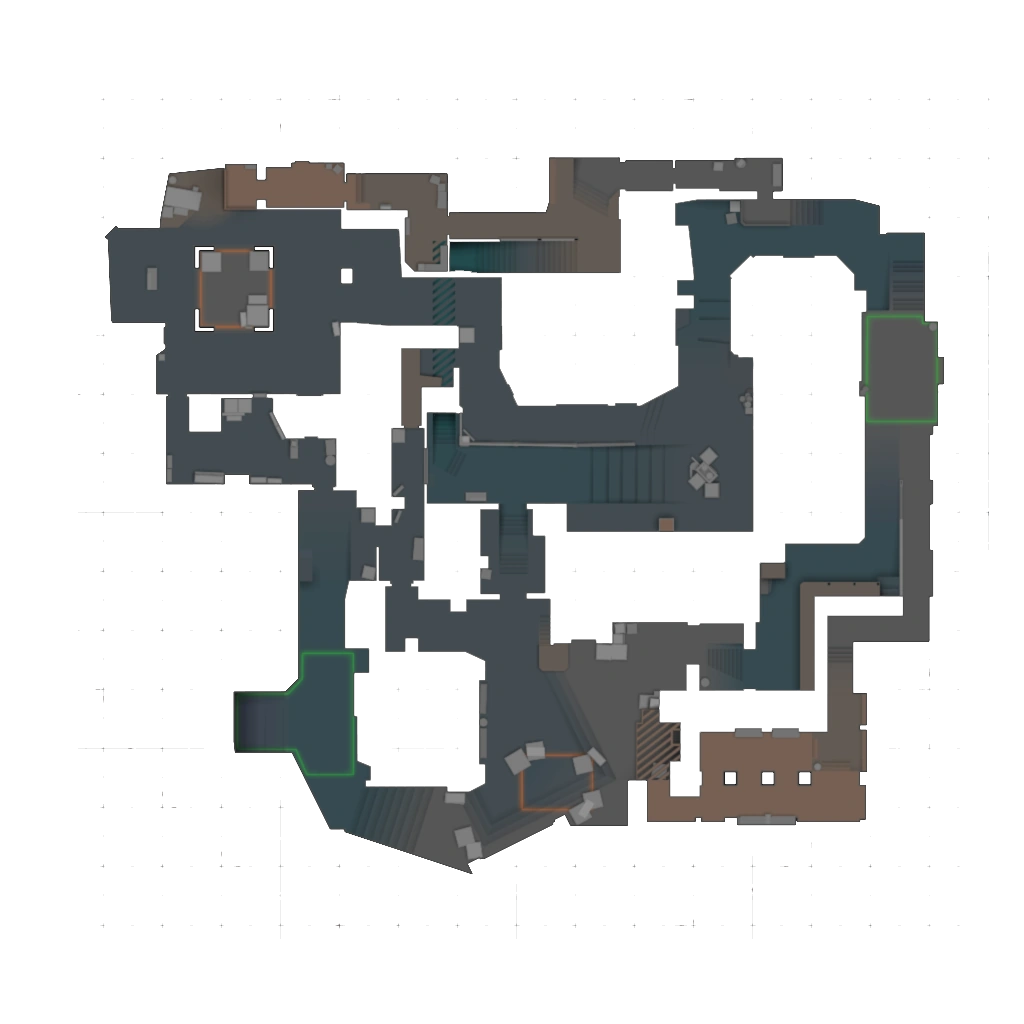
Most players never touch the default radar, which is a mistake. The default configuration centers on your position and cuts off large portions of the map. You’re missing enemy positions your teammates have already spotted, rotations happening across the map, and utility being deployed in areas outside your view.
Three changes fix this immediately:
cl_radar_always_centered 0— keeps the full map visible instead of centering on youcl_radar_scale 0.4— zooms out so you see more of the map at oncecl_hud_radar_scale 1.3— makes the minimap large enough to actually read mid-round
These settings alone give you significantly more usable information every round. There’s no reason to play without them.
How to actually read the minimap
Glancing at the minimap is a habit, not something you do after you die wondering where that came from. The key is tying radar checks to specific moments in the round so it becomes automatic rather than something you have to consciously remember.
Check the radar when you:
- Step behind cover
- Finish an engagement
- Switch weapons
- Move between positions
During those moments you’re not in an active duel, so checking the radar costs you nothing. You’re looking for three things: where your teammates are, where spotted enemies are, and any gaps in your team’s coverage.
Avoid staring at the minimap during fights. Short, deliberate glances in low-pressure moments are enough.
Positioning and map awareness are connected
If you’re constantly taking aggressive duels and pushing into contact, you’re rarely in a safe enough position to process information. Map awareness requires brief windows of low pressure, and those only exist when you’re behind cover or holding a stable angle.
Players who take impulsive fights lose both the duel and the information they could have gathered by pausing for a second. More patient positioning creates the mental space to actually use what the radar is telling you.
Use audio as a second radar
The minimap shows you what teammates have spotted. Audio fills in everything else.
Footsteps, reload sounds, and utility, grenades bouncing, Molotovs igniting, flashes popping, all give away enemy positions before you have visual confirmation. A good player is constantly building a mental picture from sound alone, so the radar just confirms what they’ve already started to predict.
Train yourself to consciously process audio as information rather than background noise. When you hear something, ask yourself: where was that, and what does it mean for where I should be?
Learn callouts for every map you play
Callouts turn individual sightings into team-wide information. One player spots an enemy and calls the position, every teammate immediately updates their mental picture of the round. Without shared callout language, that information either doesn’t get communicated or causes confusion.
It works in both directions. Giving callouts trains you to process and communicate positions quickly, which sharpens your own spatial awareness. Receiving them fills in parts of the map you can’t see, making your radar reading more complete.
If you don’t know the callout names for a map, you can’t communicate clearly or respond when a teammate calls something out. Spend time on community training maps designed specifically for callout practice before grinding competitive matches, it pays off fast.
Review your own demos
Demo review is probably the most underused improvement tool at lower skill levels, and it’s directly relevant to map awareness.
After a match, go back and watch rounds where you died unexpectedly. Pull up the radar at the moment of the death and look at what information was already available. In most cases, you’ll see that a teammate had already spotted the enemy, or that the audio cues were there, you just weren’t processing them.
Patterns become obvious over multiple reviews. Getting repeatedly flanked from the same direction. Missing that your team left a site completely uncovered. These are fixable habits, but you won’t notice them in real time.
Learn rotation timings
Map awareness isn’t just about knowing where enemies are right now, it’s about knowing where they can be. Each map has specific rotation timings: how long it takes to get from one bombsite to another, how fast an enemy can reach a position from where they were last spotted.
Once you know the timings, you stop guessing. You can judge whether an enemy could realistically be somewhere before you peek it, or whether a rotation is still possible after a late call. This is what separates players who react to threats from players who anticipate them.
Map awareness compounds over time. Better radar settings give you more information. Better positioning gives you time to process it. Callouts and audio fill in the gaps. Demo review closes the loop. Start with the radar settings today, the rest builds from there.